Case Studies
Strategic marketing programs built to navigate complexity, competition, and clinical nuance.
Case Study 1: Two Birds, One Stone
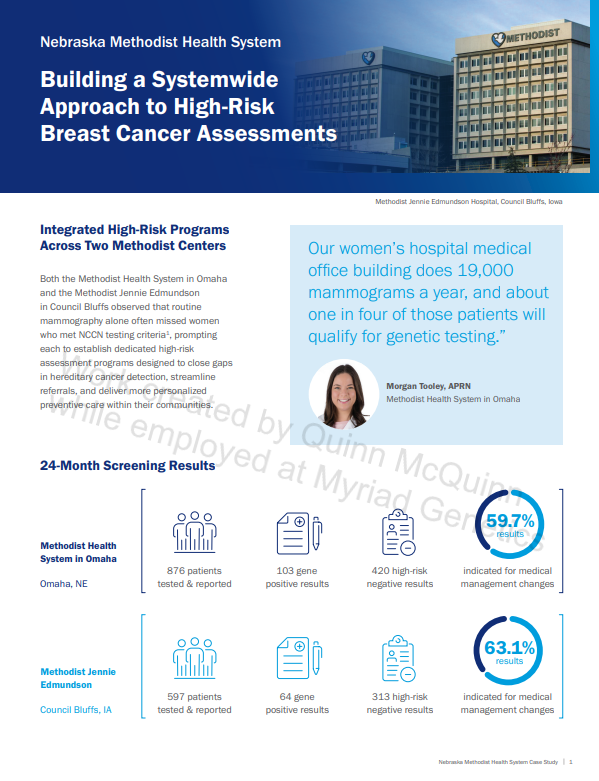
I led the development and deployment of an integrated education and marketing campaign supporting large health system’s risk assessment program, designed to engage surgeons and hospital leadership while increasing organizational understanding of clinical risk stratification and its operational value.
The work extended beyond content creation. I translated complex risk assessment concepts into clear, executive-ready narratives tailored for surgical audiences and C-suite decision-makers, then operationalized that messaging across sales enablement tools, digital channels, and leadership-facing communications. Core materials were built to support informed, high-level conversations with clinicians and administrators and were strategically repurposed into sponsored educational content, including a national placement in Business Reporter, to expand reach and reinforce credibility at the system level.
Client
Nebraska Methodist Health System
Date
Fall 2025
Case Study 1 Overview
Challenges
Surgeon testing volume historically softened in Q4, creating a recurring gap in momentum across core clinical audiences.
The challenge was to responsibly leverage a strong-performing health system as a proof point to help stabilize broader surgeon engagement, while also elevating the narrative for C-suite decision-makers evaluating long-term program value
Strategy & Execution
I developed a dual-audience strategy positioning risk assessment as both a clinical decision-support tool for surgeons and a strategic lever for health system leadership. Modular messaging was deployed through field-facing educational assets and then repurposed across digital channels and sponsored thought leadership.
Results
The campaign helped stabilize surgeon engagement during a historically slower quarter by grounding conversations in a proven health system example rather than abstract claims. Sales teams were equipped with clearer, executive-ready materials.
Case Study 2: Competitive Pressure
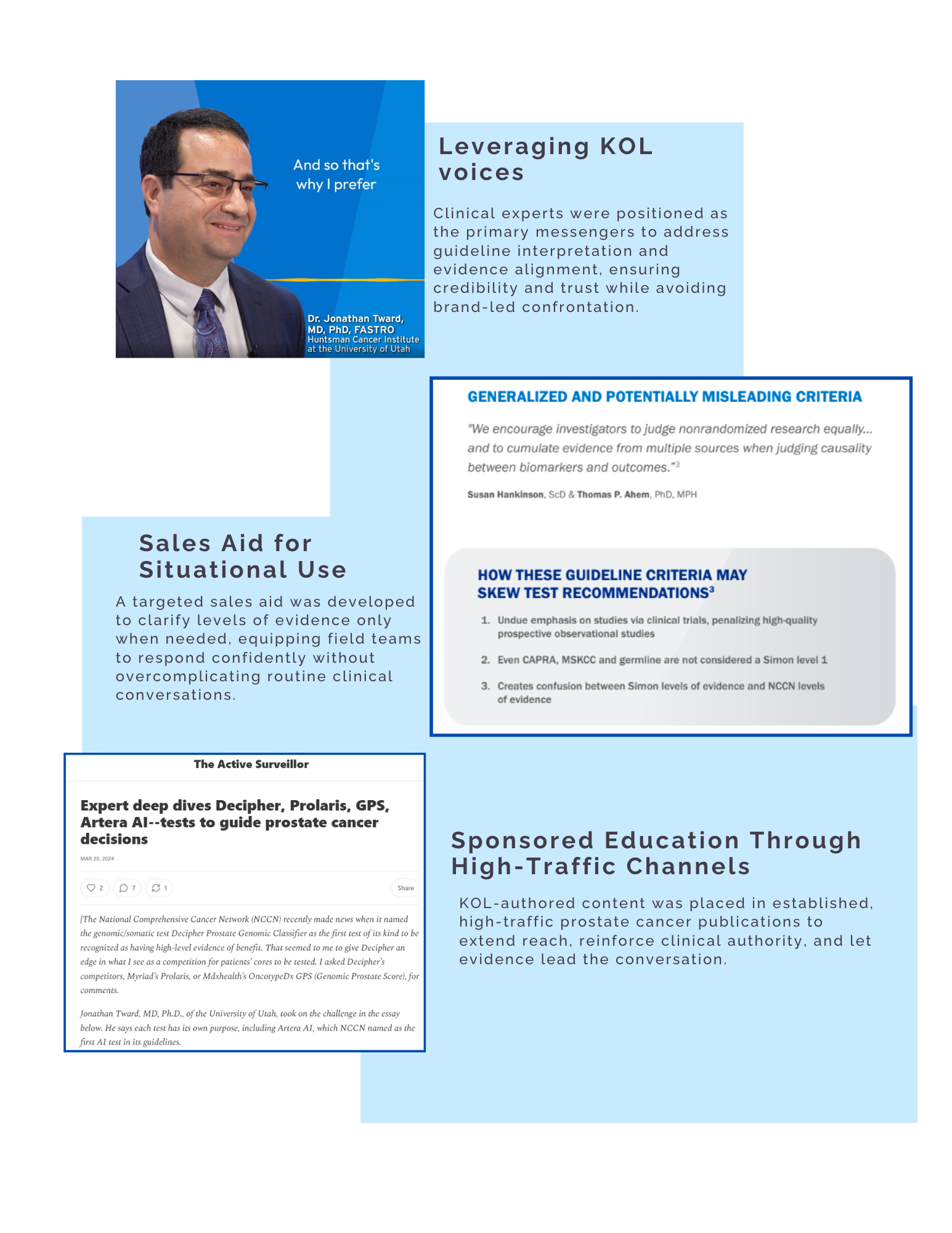
I led an omnichannel competitive positioning effort in response to misleading guideline interpretations that were driving share toward a competitor based on clinical validation. Rather than engaging in reactive, rhetoric-driven rebuttals that risked confusing urologists, I reframed the conversation around clinical appropriateness, anchoring our test as the strongest option for untreated prostate cancer patients and active surveillance, the largest segment of the market.
The strategy emphasized credibility over confrontation. We acknowledged where the competitor was appropriately validated while clearly differentiating where our evidence was superior.
This approach protected clinical clarity, empowered sales with defensible messaging, and preserved trust with providers while addressing both immediate competitive pressure and long-term guideline integrity.
Client
Urologists (North America)
Date
2024 - 2025
Case Study 2 Overview
Challenges
These criteria were unlikely to be removed from guidelines in the near term, and a reactive or retaliatory response risked alienating urologists and introducing unnecessary confusion into an already complex decision landscape. Directly disputing the criteria in-market would have created a lose-lose scenario, undermining trust while amplifying competitor messaging rather than refocusing clinicians on the clinical question that mattered most.
Strategy & Execution
I led a credibility-first, omnichannel strategy that shifted the conversation away from guideline rhetoric and toward clinical appropriateness. Execution included a KOL-led podcast, repurposed into short-form social soundbites, a dedicated chapter within our speaker deck explaining the criteria through a respected clinical voice, sponsored educational blogs, and paid media reinforcing us as the best test for active surveillance.
Results
The approach preserved trust with urologists while restoring commercial momentum. Medical affairs made measurable progress in building consensus around the misapplication of the criteria, and sales teams saw win-back success that brought performance back to goal, with several territories exceeding targets. By reframing the conversation around clinical fit rather than controversy, the campaign supported both near-term recovery and longer-term guideline correction.
Case Study 3: Unlocking a New Segment
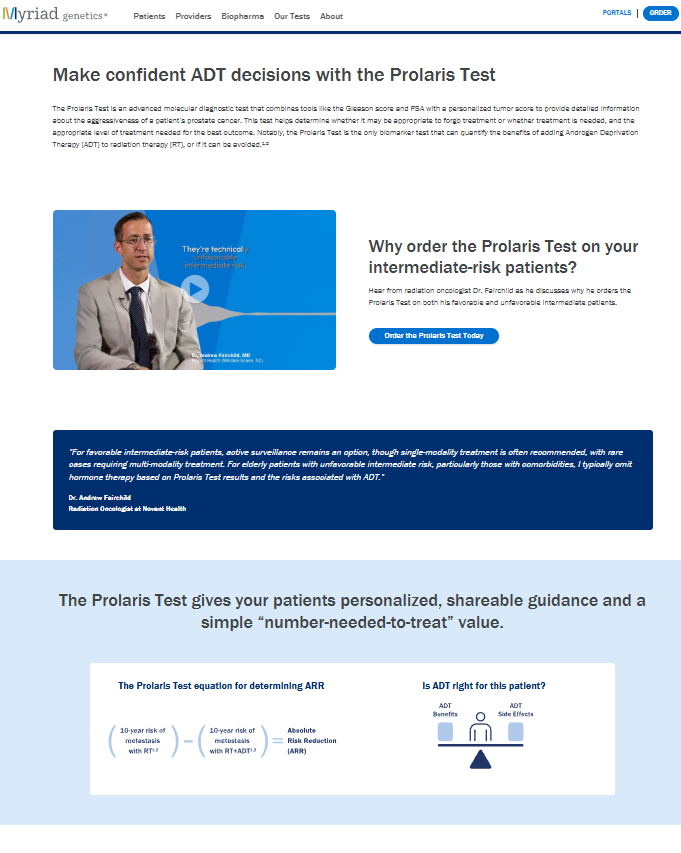
I led the strategic repositioning of a newly launched reporting feature that quantified the benefit of androgen deprivation therapy (ADT) when used alongside radiation therapy for advanced prostate cancer patients. While the initial launch was built for a urologist audience, early feedback revealed the feature’s strongest clinical relevance and influence lay with radiation oncologists, a highly impactful segment that was largely underserved by competitive marketing efforts.
Rather than forcing adoption within a misaligned audience, I developed a new segment strategy that preserved urologist engagement while expanding reach to radiation oncologists through tailored playbooks, role-specific sales aids, targeted event presence, and paid media. The campaign reframed the feature around referral influence and shared decision-making, positioning radiation oncologists as a critical lever in treatment planning while maintaining continuity across the broader care pathway.
This shift unlocked a new growth opportunity, aligned messaging with real-world clinical workflows, and demonstrated how product marketing can adapt quickly to audience insight without compromising launch integrity.
Client
Radiation Oncologists (North America)
Date
2023
Case Study 3 Overview
Challenges
The initial launch was heavily oriented toward urologists, with significant investment in sales materials built for a single audience. It became clear that this addition was most relevant to radiation oncologists, creating a dual challenge: avoiding wasted effort tied to the urologist-focused launch while rapidly building credibility, access, and messaging for a segment the organization had limited prior experience engaging.
Strategy & Execution
Through VOC insights, we found that radiation oncologists were more academically driven and study-focused, shifting the strategy away from awareness-building toward evidence-based differentiation.
In response we contracted radiation oncologist speakers, reallocated paid media/conference spend, and developed new segment-specific sales aids. Existing materials were preserved and selectively adapted, ensuring both audiences were addressed without duplicating effort.
Results
The campaign unlocked a new, high-volume customer segment with outsized influence over treatment planning and referral decisions. Radiation oncologists emerged as a meaningful growth lever, strengthening downstream engagement with urologists while expanding the product’s role across the care continuum. This segment-led repositioning increased adoption momentum and established radiation oncology as a durable channel for future growth initiatives.